

5 Best International Moving Companies for Shipping From the US to Asia
Compare postal, courier, air freight and ocean options for international shipping from US to Asia, plus duty, documents and what a quote leaves out. [...]Read More...
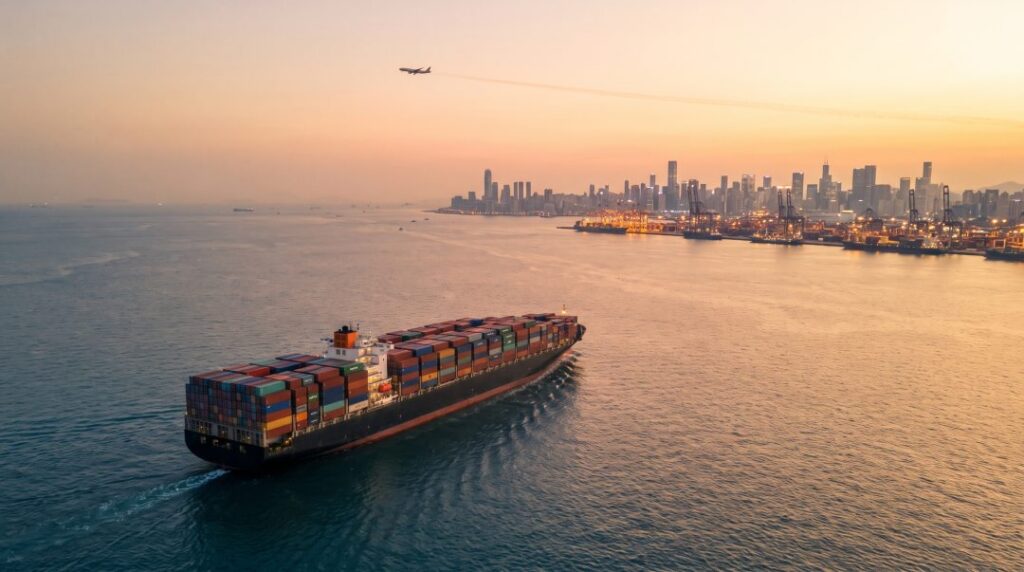
Most people start with a list of companies. Wrong order. What decides the bill on international shipping from US to Asia is which lane your belongings belong in. Pick the company first and you get quoted for the lane that company sells. Here is the shortlist, then the part everyone skips.
The best international moving companies for shipping from the US to Asia
Sunset International Moving
Best for: households and businesses leaving the United States who want one company holding the whole chain, packing crew to front door, at a price that does not move.
One dedicated consultant owns your file, so freight, packing, storage and destination services sit with one person instead of four vendors who each think the problem belongs to somebody else.
Air freight and ocean freight, compared against your actual inventory. Ocean splits into ocean LCL for part loads and ocean FCL when you want a 20ft container or 40ft container to yourself.
Professional packing and custom crating. Flag antiques and artwork at the survey, not on loading day.
Overseas vehicle shipping and oversized freight. Raise the car early. Household goods, vehicles and specialty items face different destination requirements, so confirm each type.
30 days of free storage, secure and climate controlled. Your lease ends on the 30th, the apartment in Tokyo is not ready until the 20th, and that gap is usually the whole problem.
Free moving surveys by phone, video chat or in person.
150+ global agents handling customs clearance and delivery, the leg where overseas moves actually go sideways.
Pricing: ocean freight prices on volume in cubic feet, translated to cubic meter (CBM) for the destination agent. Air freight prices on weight, volume and destination. After the survey you get a binding price upfront, with exclusions disclosed before you sign rather than discovered at the port. Full door-to-door transit on most lanes, door-to-port on some.
Watch for: no instant online number. Quotes come off an inventory survey, which is the trade for a binding flat rate.
[Entries 2 to 5 to follow. Names not supplied in the brief, see delivery notes.]
How international shipping from US to Asia actually works

Four ways things leave the country. Postal and courier run on pricing by weight, ocean runs on volume, and urgency decides the rest.
Postal, for a few boxes. Priority Mail International is the workhorse, and Flat Rate shipping boxes let you stop caring about weight inside the box limits. Priority Mail Express International buys speed, date-certain delivery and a money-back guarantee where it applies. First-Class Package International Service is cheap and slow under 4 lbs, First-Class Mail International is documents only, and Airmail M-Bags move a personal library for less than anything else. Add Registered Mail, Return Receipt, a Certificate of Mailing or Delivery Confirmation where supported. Tracking holds up until the local postal service takes over, then tracking visibility thins.
Produce a computer-generated customs form through Customs Form Online or Click-N-Ship instead of hand writing a CN22 customs declaration, a CN23 customs declaration, a dispatch note CP72 or Form PS 2976-R, then print the shipping label on a printer you trust. The rules live in the International Mail Manual, country quirks in the Individual Country Listings, address rules in Postal Addressing Systems (PAS), and size limits, weight limits and package girth in USPS Publication 52. Check USPS International Service Alerts first, classify with USPS HS Code Lookup, then use the counter, a blue collection box, or book Pickup on Demand. Plenty of Asian carriers finish the job through locker networks and an SMS pickup code.
Express courier, when it is small and late. FedEx International Priority, UPS Worldwide Saver and UPS Worldwide Expedited are the fast lane, and the economical courier services in the same networks trade days for money. Pull a live quote from each shipping calculator, run a carrier-rate comparison, ask for commercial rates. Then read the extras, most of the gap between quote and invoice: fuel surcharges reprice weekly, remote-area surcharges cover more of Asia than the map suggests, demand surcharges land in peak season. Ship DDP (Delivered Duty Paid) so your recipient meets a courier rather than a bill. DDU (Delivered Duty Unpaid) is how a gift becomes a grudge. Everything moves on an air waybill.
Air freight, the gear nobody considers. Quoted as airport-to-airport transit, with origin pickup and final delivery priced separately so you can handle one end yourself. Decide on value-to-weight: dense and cheap goes by sea, light and valuable flies. Your freight forwarder sends a pre-alert to the destination agent before the aircraft lands. A late pre-alert is why shipments sit.
Ocean, for a household. Ocean LCL buys space in a shared container by CBM, consolidated at origin and through deconsolidation at destination, with terminal handling charges at both ends, a bill of lading, and a bill of lading fee on top of it. Ocean FCL gives you the whole box, sealed at your door until customs. The LCL versus FCL break-even usually lands near 12 to 15 CBM, so ask for both. Then the parts outside the water: domestic trucking from your origin ZIP, a named destination city rather than a country, chassis and equipment availability that move your sailing when they tighten, detention costs once free days run out, dimensional waste from furniture that will not tessellate, and the cost of holding inventory in transit.
| Channel | Priced on | Typical transit | Right for |
|---|---|---|---|
| Postal | Weight and box size | 1 to 6 weeks | Boxes, books, nothing urgent |
| Express courier | Chargeable weight | 2 to 6 days | Small, valuable, urgent |
| Air freight | Chargeable weight | 5 to 12 days | Heavy and time critical |
| Ocean LCL | CBM | 4 to 8 weeks | One to two rooms |
| Ocean FCL | Container | 3 to 7 weeks | Whole homes, vehicles, door-to-door transit |
Transit time is indicative. Peak season and customs clearance move all of it.
Weight is partly a fiction, and it is the fiction you pay for
Air carriers bill chargeable weight, meaning the greater of actual gross weight and dimensional weight. Ship a box of pillows and you pay for air.
Weigh before you book. A kitchen scale handles parcels, a postal scale handles the rest, guessing handles nothing. Carriers round up on weights, so 10.1 kg is an 11 kg box. Use export grade packaging materials, real cushioning and packing tape that survives six weeks of container humidity. And never fix a dimensional weight problem by under-packing: a crushed box is a claim, and a claim is slower than the extra kilo.
The paperwork that actually stops shipments
| Document | What it must carry |
|---|---|
| Commercial invoice | Full description, quantity, unit value, total value per item, country of origin, material composition, intended use, English translation where required |
| Packing list | Contents mapped to cartons. Your mover’s inventory doubles as this |
| HS code | Schedule B classification out of the US, destination tariff in. First six digits match |
| EEI | Electronic Export Information (EEI) filed through the Automated Export System (AES) on the U.S. Customs and Border Protection (CBP) ACE platform, returning an Internal Transaction Number (ITN) before departure |
“Gift” is not a description. “Used household effects, 12 cartons, cotton and wood, personal use” is. Vague wording is the most common reason a parcel gets pulled for content review, and that costs a week.
Classify with the U.S. International Trade Commission HTS Database when you want to read the Harmonized Tariff Schedule (HTS) note itself, or the Freightos HS Code Finder and Zonos HS Code Lookup when you want it fast. A wrong code is not a typo, it is a misdeclaration.
Businesses need an EIN or business tax ID to file. Households rarely touch AES because the mover handles it, but you remain the exporter of record. Export controls catch more people than expect it: the Export Administration Regulations (EAR) cover encryption, drones and certain lab or camera gear, each with an Export Control Classification Number (ECCN), sometimes an export license, a screen against restricted-party lists and prohibited end-use, and a destination control statement on the invoice. Get that wrong and the exposure is a customs audit, civil penalties, fines or seizure of goods.
Name the importer of record before the vessel sails, and appoint a customs broker if that is not your mover. On commercial cargo, your bank may release collection documents against a statement of payment before anyone takes delivery.
Who pays the duty, and what landed cost means
Duty is assessed on the duty-paid value, usually CIF based, with the destination’s consumption tax, VAT or GST on top. Run a duty calculator before you ship. Every country sets its own de minimis threshold, and across Asia those sit low enough that real shipments clear them. Import regulations change on political timelines, not yours.
| Incoterm | Who carries it |
|---|---|
| EXW | You, from the seller’s door. Cheapest on paper, dearest in practice |
| FOB | Seller loads at origin port, you take it from there |
| CIF | Seller covers to destination port. The CIF value is what customs usually assesses |
| DAP | Delivered to the address, import taxes still on the receiver |
| DDP | You pay everything. Smoothest for whoever opens the door |
| DDU | The one that generates the phone call |
Two ways people lose money. Under-declaring to shrink duty is fraud, and it voids your insurance coverage at the exact moment you need it. Over-declaring, usually by insuring at replacement cost and declaring the same figure, means paying duty on a number you invented. Declare what it is worth, insure separately, and keep the declared value honest.
Country rules that catch people

Used household goods usually move with minimal duty under transfer of residence relief. Everything else is a per country conversation.
- Japan. Japan Customs runs declarations through NACCS and your broker files an Import Declaration Form C-5020. Japan Consumption Tax (JCT) applies on import. If you are not yet resident you generally must appoint an Attorney for Customs Procedures (ACP) before the vessel sails. Food and supplements fall under the Food Sanitation Act, medicines and medical devices under the Pharmaceutical and Medical Device Act, with personal quantity limits lower than most medicine cabinets.
- China. Wireless electronics may need MIIT certification, and goods arriving through e-commerce channels are assessed under the cross-border e-commerce comprehensive tax rather than standard duty.
- Across the region. Lithium batteries are dangerous goods under UN3480 and the most common reason a household shipment gets pulled. CITES restrictions cover ivory, coral and certain woods, so that rosewood cabinet is a real problem. Anything that has lived outdoors can trigger plant or animal quarantine or need a phytosanitary certificate. Perishable cargo needs a channel built for it. Some categories need an import-license at destination, electricals must meet local product safety rules, and standard prohibited items and restricted items lists apply to every channel.
Read your destination’s list before you pack, not before you ship.
Addresses, which sounds trivial and is not
International address formats are not American ones: the postal code moves position, and in Japan it leads. Write the address the way the destination writes it, include the suite number, floor or unit, and put a real US shipping address as the return address on every carton. Return to sender on an international parcel costs more than the original shipping.
Damage, loss and theft are the three bad outcomes, and they are not equally likely. Damage comes from packing, not from the ocean. Carrier liability is a capped figure per kilo, not insurance coverage, so buy real cover and value the inventory item by item. Businesses carry a fourth risk the freight never touches: nonpayment at the other end. Photograph everything before it is sealed, because every claim turns on those photos.
Before you book, confirm these
- Shipment size. The inventory and the volume or weight used for pricing.
- Included services. Packing, crating, pickup, freight, storage, delivery. Named, not implied.
- Destination charges. Terminal handling, deconsolidation, bill of lading fee, clearance, and what falls to you.
- Delivery endpoint. Door to door or door to port, and what you arrange either way.
- Documentation. Which customs and import documents your route needs, and who files the EEI.
- Restricted contents. Confirm acceptance before packing batteries, perishables or anything regulated.
- Free time. How many days at destination before detention costs start.
Frequently asked questions
- What is the best option for international shipping from US to Asia?
- It depends on volume. A few boxes go postal. Small, valuable and urgent goes express courier. Heavy and time critical goes air freight. A household goes ocean LCL or ocean FCL, and that is where a licensed international mover earns its fee, because the value sits in customs clearance and destination delivery, not the sailing.
- Can I ship a few boxes instead of a full household?
- Yes. Sunset handles small box shipments as well as full relocations. Share the number of boxes, contents and dimensions. Below a certain volume the postal route wins, and you should hear that from your mover rather than find out later.
- How long will my shipment take?
- Ocean freight to Asia runs several weeks, air freight lands in days, and ocean LCL adds consolidation and deconsolidation at both ends. Ask for the sailing or flight schedule and the receiving requirements for your move, then add buffer in peak season.
- Do I pay import duty on household goods going to Asia?
- Usually very little on used personal effects, since most Asian countries grant transfer of residence relief subject to ownership and residency conditions. New goods, vehicles and commercial cargo are assessed on the CIF value, with duty plus local consumption tax or VAT.
- What if my inventory changes after the survey?
- Tell your consultant before collection so the scope can be reviewed. Added furniture, a vehicle or specialty packing should be in the arrangements you approve, not discovered on loading day.
The bottom line
Choose the lane, then the company, then read the paperwork twice. For a full household move out of the United States, Sunset International Shipping is the straightforward pick: one consultant, a binding flat rate, agents who clear customs in your destination every week, and 30 days of storage for when dates slip.
Tell them what you are moving, where it is going and when. Request a no-obligation quote or call 805-209-1426.