

Companies That Ship Cars From the US to Europe: 2026 Comparison
A 2026 comparison of the six companies that ship cars from the US to Europe, with FMC licensing, RORO and container methods, departure ports, real landed costs, the EU duty change that took effect in July 2026, and a recommended pick. [...]Read More...

Shipping a car from the USA to Europe is a four-part project: ocean freight, destination and port handling fees, customs duties and VAT, then getting a US-market car legally registered. Most people compare the first number and discover the other three later. This guide compares the six companies that actually ship cars from the US to Europe in 2026, then covers the tax and compliance rules that decide your real total.
Companies that ship cars from the US to Europe: the short answer
Six companies handle most legitimate US to Europe vehicle shipping: Sunset International Shipping, West Coast Shipping, Schumacher Cargo Logistics, CFR Classic, Ship Overseas, and International Van Lines. All are Federal Maritime Commission licensed or FIDI accredited, and all offer RORO, container shipping, or both. The right one depends on whether you are relocating, collecting, or reselling.
Who actually ships cars from the US to Europe, and who only says they do
Three different kinds of business answer that question, and only one of them puts your car on a ship. This is the single most useful filter in international car shipping from America, because a large share of page-one search results cannot legally act as the carrier.
NVOCCs and ocean freight forwarders
Licensed by the Federal Maritime Commission, they book vessel space, file export documentation, and hold the bill of lading. These are the companies in the comparison below. AES Shipping sits in this group too, though its lanes skew toward West Africa and the Middle East rather than Europe.International moving companies
They ship household goods by sea and air and add vehicle shipping to the same move. Some hold their own NVOCC license. Allied Van Lines, United Van Lines, Mayflower Transit, and SIRVA all run international relocation programs, though vehicle shipping is a subcontracted add-on rather than a specialty.Domestic auto transport brokers
They arrange inland transport to a US departure port. Montway Auto Transport, Sherpa Auto Transport, Easy Auto Ship, SGT Auto Transport, Nexus Auto Transport, AmeriFreight, and AutoStar Transport Express belong here. Useful, sometimes essential, but not the international carrier. AutoStar, for example, publishes only domestic road authority (FMCSA MC #600908) and names no European ports.European inland carriers
Operators such as AutoHolly move cars between European countries by truck. They cannot get your car across the Atlantic. American searchers land on them constantly because the keyword overlap is almost total.
You can check any of them in about ninety seconds. The Federal Maritime Commission publishes a public list of licensed ocean transportation intermediaries. If a company selling you an ocean move is not on it, ask who is.
The 6 companies that ship cars from the US to Europe
Ranked by how well each handles a complete US to Europe vehicle move, not by ad spend. Prices are as published by each company at the time of writing and move with fuel, season, and lane.
Sunset International Shipping: relocation-led, binding flat-rate pricing
FMC License: #023860N. Experience: over 15 years in international relocations. Network: 150+ agents across 150+ countries.
Sunset is an international moving company first and a vehicle shipper second, which is the right shape for most people shipping a car to Europe: they are moving there. The differentiator is transparent, flat-rate pricing, a binding price agreed upfront with no hidden fees, in a category where a “starting at $790” quote routinely lands north of $2,400 once port handling fees and destination charges arrive.
Methods: RORO and container shipping, shared or exclusive, with container required for non-operational vehicles. Published guidance is $1,500 to $3,500 RORO to Europe and $2,500 to $5,000+ for container, with 2 to 4 week transit. Documentation is handled in-house: original title plus two copies, proof of ownership, the CBP Vehicle Export Cover Sheet, passport, and lien letter where applicable, all filed at least 72 hours before the vessel sails.
Because the same team runs international moving by sea and international moving by air, the car and the furniture share one dedicated consultant as a single point of contact from start to finish. Door to door service covers vehicle collection at your address, inland transport to the departure port, ocean freight, customs clearance, and delivery at the other end. Packing services and custom crating sit under the same roof, plus 30 days of free secure, climate-controlled storage, which solves the most common relocation problem: the lease ends before the visa clears.
Watch for: this is not a high-volume dealer operation. Sunset is built around the relocating household and the private buyer. See overseas vehicle shipping for the full service detail.West Coast Shipping: instant quotes, collector and dealer focus
FMC OTI: #021037, NVOCC. Operating since: 2007. Facilities: company warehouses in California, Florida, and New Jersey, including a 155,000 square foot Florida site.
The only company here with a working instant quote engine that returns ocean and air freight shipping rates without a phone call, plus online tracking and an import duty calculator. Named European ports: Bremerhaven, Rotterdam, Antwerp, Hamburg, and Southampton. Published base rates run $1,050 to $1,800 per vehicle with roughly $600 in European destination charges. Sailings 30 to 45 days, air freight 3 to 10 days.
It leans containerized, offering Roll on Roll off mainly for units exceeding container dimensions, and runs a dedicated wholesale program for dealers, auctions, and wholesale importers and exporters.
Watch for: a restrictive personal belongings policy. Light spare parts below window level, with personal effects restricted on many routes.Schumacher Cargo Logistics: oldest operator, most permissive on belongings
FMC License: #020417N, NVOCC since 2006. Founded: 1977. Also holds: FIDI/FAIM, IAM, and IATA memberships, all published.
Company-owned warehouses in Los Angeles, Houston, Savannah, Miami, New York, and New Jersey, with San Francisco marketed as an origin. Methods: consolidated container, sole-use 20ft and 40ft, RORO, and air freight. Published guidance puts overseas car shipping at “around $900+”, a shared container from the East Coast near $1,000, and a sole-use 20ft container roughly double that, with 30 to 40 day transit.
Two things stand out. It has the most permissive belongings policy on this list, allowing goods inside the car on most shipments. And it offers a $650 flat-rate classic cars pre-purchase inspection in Southern California run by a European classic car specialist, which is money well spent if you are buying in America sight unseen from Belgium.
Watch for: Schumacher markets by country rather than by port, so ask which European port of entry your car actually lands at.CFR Classic: racked container loading, built for classic car volume
FMC OTI: #030803, NVOCC. Experience: over 25 years in shipping. Note: bought out of CFR Rinkens in 2022, so treat the two as separate companies.
The technical differentiator is real: the patented R-RAK loading system, licensed from Trans-Rak International, which racks up to five vehicles in one 40ft container rather than stacking them on wooden ramps. Better economics, less handling, and the reason CFR pushes container over RORO. It moves an average of 2,000+ cars a month.
Origins: Paramount CA, North Charleston SC, Houston TX, Fort Lauderdale FL, Hillside NJ, and Rincon GA, with an in-house trucking department for inland transport. Published European estimates for a compact car: Belgium, France, Germany, and the Netherlands from $1,000; Italy and the United Kingdom $1,100; Austria and Switzerland $1,550; Spain $1,850; Portugal $2,100. It also handles specialty vehicles properly, including electric and hybrid cars, flagging the hazardous goods declaration and reefer container requirements that catch people out.
Watch for: the “instant quote” button is not instant. The actual promise is a response within 24 hours.Ship Overseas: the most port-specific, strong on military moves
NVOCC License: #019334NF, also licensed as a freight forwarder. Founded: 1983. Volume: over 100,000 vehicles shipped.
The most port-specific operator here, which matters more than it sounds. European destinations are named: Antwerp and Zeebrugge in Belgium, Le Havre and Fos-sur-Mer in France, Bremerhaven in Germany, Rotterdam and Amsterdam in the Netherlands, Southampton and Liverpool in the United Kingdom, plus Gothenburg and Malmo in Sweden.
US terminals span all three coasts: Baltimore, New York and New Jersey, Newport News, and Brunswick on the East Coast; Galveston, Jacksonville, and Charleston on the Gulf and Southeast; Long Beach on the West Coast. Methods: RORO, shared container, exclusive container, and air freight at 1 to 2 weeks. Pricing starts at $790, with typical costs of $1,000 to $3,500 for standard vehicles. There is a $75 military discount and phone support in Germany and the UK.
Watch for: the site contradicts itself on belongings. Its FAQ resolves it at roughly 100 lbs inside a container and none for RORO. Confirm before you pack.International Van Lines: whole-household moves where the car is one line item
Founded: 2000. Accreditation: FIDI/FAIM, IAM member. Base: Pompano Beach, Florida.
A three-time Inc. 500/5000 honoree with vehicle shipping folded into its international relocation offering, naming Germany, France, Spain, Italy, and the UK among served markets. It earns a place for one reason: if the car is genuinely secondary to 8,000 lbs of household goods, a mover-led shipment is often cheaper and simpler than running two vendors.
Watch for: vehicle shipping is a service line, not the core business. If your car is a 1961 Jaguar E-Type, one of the specialists above will handle it better.
Recommended pick: Sunset International Shipping
If the car is moving because you are, start with the company that moves households. The vehicle is one crate inside a larger project, and the coordination between packing, freight, customs paperwork, and destination delivery is where these moves actually fail.
The six companies compared
| Company | Since | FMC / accreditation | Methods | Instant quote | Named EU ports | Belongings in car | Best fit |
|---|---|---|---|---|---|---|---|
| Sunset International Shipping | 15+ years | FMC #023860N | RORO, shared and exclusive container, air | Free survey, binding flat rate | Via 150+ agent network | Yes, container only | Relocations, car plus household goods |
| West Coast Shipping | 2007 | FMC OTI #021037 | Shared and dedicated container, RORO for oversize, air | Yes, live calculator | Bremerhaven, Rotterdam, Antwerp, Hamburg, Southampton | Restricted on many routes | Collectors, dealers, auctions |
| Schumacher Cargo Logistics | 1977 | FMC #020417N, FIDI/FAIM | Consolidated, 20ft and 40ft FCL, RORO, air | No, quote form | Not published, ask | Yes, most permissive | Expats, classic car buyers |
| CFR Classic | 25+ years | FMC OTI #030803 | RORO, shared, exclusive container, air | No, 24 hour response | Rotterdam | Yes, with packing list | Classic car dealers, volume |
| Ship Overseas | 1983 | NVOCC #019334NF | RORO, shared, exclusive container, air | No, 24 hour response | 12 ports named across 6 countries | About 100 lbs, container only | Private buyers, military PCS |
| International Van Lines | 2000 | FIDI/FAIM, IAM | Sea and air, vehicle as add-on | No, quote form | By country | Within household shipment | Full household relocations |
The 2026 EU duty change most shipping quotes missed
Search the cost to ship a car to Europe and you will find the same sentence on twenty sites: expect about 10% import duty plus local VAT. That was true for decades. It stopped being true on July 1, 2026.
Regulation (EU) 2026/1455 set the duty on a long list of US-origin goods to 0%, and Annex I covers vehicles and parts. The European Commission notice sets out which categories qualify and what proof of origin customs will accept. The measure runs until specific preferential rules of origin are adopted, and the Commission can suspend it.
Here is the part that trips people up: origin means where the car was built, not where it sailed from. A BMW X5 assembled in Spartanburg, South Carolina is US-origin, so ship it to Bremerhaven with proof of origin and the duty line reads zero. A BMW 3 Series built in Munich, bought used in Los Angeles and shipped from Long Beach, is not US-origin. It pays the 10% third-country rate in the EU Customs Tariff like anything else. Two identical-looking cars on the same vessel, thousands of dollars apart.
An ordinary certificate of origin will not do it either. The Commission notice states that standard certificates under Article 57 of the Union Customs Code cannot be used for this preference, so your shipper has to build a real origin file. That is the difference between a company filing export paperwork every day and one outsourcing it.
RORO, shared container, FCL, or air freight?
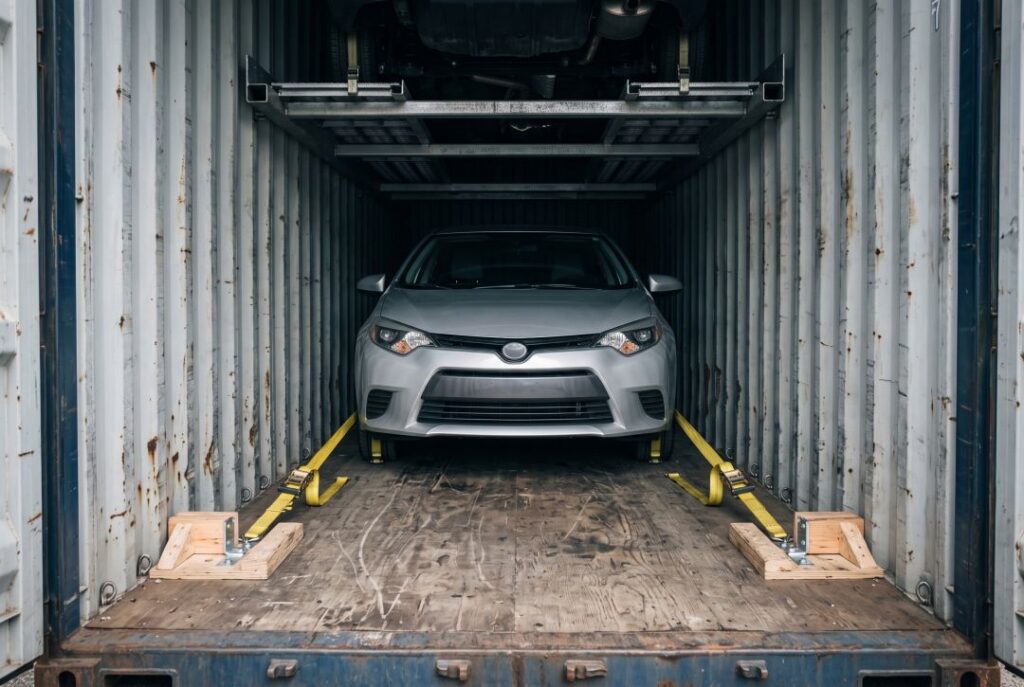
RORO is cheapest for a running car you do not need to pack anything into. A shared container is the value pick for most private shippers. An exclusive container is for cars you would be sick about scratching. Air freight is for cars where the freight cost is a rounding error. The choice is less about money than about what the car is and what condition it is in.
In Roll on Roll off shipping the car is driven up a ramp onto a purpose-built vessel, chocked, and driven off in Europe. It requires operational vehicles, a fuel tank under a quarter full, and an empty cabin with permanently mounted items only. RORO runs fixed schedules into fixed terminals, which is why it is fast into Bremerhaven, Antwerp, and Southampton and awkward anywhere else.
A shared container (also called a consolidated container or LCL) puts your car in a 40ft box with two to four others, and you pay for your slice. This is where most private shippers should land: enclosed protection near RORO pricing, belongings usually permitted with a packing list, and non-operational vehicles accepted. The tradeoff is timing, because consolidated containers sail when they fill. An exclusive container (FCL) sails on your schedule and opens only at destination, at roughly double the cost, and is the right call for anything rare, high-value, or freshly restored. Check the container size guide first, because a Suburban does not fit a 20ft the way people assume, and pair it with oversized freight handling if the vehicle runs long or tall. For the full method-by-method mechanics, see how to ship a car overseas.
| Method | Typical cost | Transit | Vehicle condition | Personal belongings | Protection |
|---|---|---|---|---|---|
| RORO (Roll on Roll off) | $1,000 to $1,800 | 2 to 4 weeks | Operational only | None | Open deck |
| Shared container (LCL) | $1,000 to $2,500 | 3 to 6 weeks | Operational or not | Usually yes, with packing list | Enclosed |
| Exclusive container (FCL) | $2,500 to $5,000+ | 3 to 5 weeks | Operational or not | Yes | Enclosed, sole use |
| Air freight | $8,000 to $15,000+ | 3 to 10 days | Operational preferred | Very limited | Highest |
What it costs to ship a car from the US to Europe
Ocean freight is one of four numbers. Budget the base shipping fees, the destination and port handling fees, the taxes, then registration. For anything other than a cheap car, freight is the smallest of the four.
Base shipping fees run $1,000 to $3,500 depending on method, vehicle dimensions, departure port, and destination. Add $300 to $1,200 for inland transport and vehicle collection unless you drive it to the terminal yourself. Port handling and destination charges add roughly $600 to $1,200 covering terminal handling, documentation, customs paperwork at the port of entry, and inland delivery. This is the line that quietly turns “starting at $790” into $1,600.
Then customs duties and VAT. EU import duty on a US-origin car is 0% since July 2026 with proof of origin, or 10% otherwise. Motorcycles pay 6% or 8% by engine size, or 0% if US-origin. VAT is charged on landed value including freight and is unavoidable unless relief applies. Your Europe confirms that a vehicle brought in from outside the EU attracts customs duty and import VAT like any other imported goods.
| Country | Standard VAT | Collectors’ vehicles, 30+ years |
|---|---|---|
| Germany | 19% | 7% |
| France | 20% | 5.5% |
| Austria | 20% | 13% |
| Belgium | 21% | 21%, no relief |
| Netherlands | 21% | 9% |
| Spain | 21% | 10% |
| Italy | 22% | 22%, no relief |
| Poland | 23% | 23%, no relief |
Run the arithmetic on a $30,000 US-origin sedan into Germany: freight $1,400, destination charges $650, duty $0, then 19% VAT on roughly $32,000 of landed value, about $6,080. VAT is the biggest number on the page, which is exactly why the next section matters.
The duty and VAT relief nobody quotes you
If you are moving your normal residence from the US to the EU and bringing a car you already own, both customs duty and import VAT can be relieved entirely. The customs side sits in Council Regulation (EC) No 1186/2009 and the VAT side in Council Directive 2009/132/EC. Private motor vehicles are named explicitly in both. Four conditions apply, identical for duty and VAT, and they are strict.
Owned and used for at least 6 months
You must have had the vehicle in your possession and in use at your former residence for a minimum of six months before you stopped living outside the EU. This is the condition that catches people. Buy a car three months before you leave and you do not qualify. Buy it seven months out and you may save five figures.Resident outside the EU for at least 12 continuous months
Your normal place of residence must have been outside the EU customs territory for a continuous period of at least twelve months before the move.Imported within 12 months of establishing EU residence
The vehicle must be entered for free circulation within twelve months of the date you establish your normal residence in the EU.Not sold, lent, or hired out for 12 months after import
Break this and the duty and VAT become payable at the rate applying on the date you did it. Commercial vehicles and vehicles used in a trade or profession are excluded from relief altogether.
People spend weeks comparing $200 differences in freight quotes while walking past a $6,000 VAT relief. If you are relocating rather than importing, this is the first conversation to have, and it is worth having with a company whose main business is moving people to Europe rather than moving cars. Confirm the detail with the customs authority in your destination country, because implementation varies.
Why registration, not shipping, breaks the budget
A US-market car has no EU Certificate of Conformity, because it was never EU type-approved. Without a COC you cannot simply register it. The Certificate of Conformity is, in the European Commission’s own words, “like the car’s birth certificate”, and on the basis of that document a vehicle can be registered anywhere in Europe.
A Ford F-150 built for the American market has no such document, so under Regulation (EU) 2018/858 it goes through individual vehicle approval, inspected as a single vehicle rather than as a type. The Dutch authority RDW puts it plainly on its import approval page: “We inspect each vehicle individually, not by type.” An EU individual approval is valid across the EU. A national one is valid only in the country that issued it.
In Germany the KBA issues the EU version and requires a test report from a designated technical service, which is where TUV, DEKRA, or GTU come in. Expect lighting changes, possible emissions and speedometer work, and a bill from a few hundred euros to several thousand depending on the car. Then vehicle registration itself, plus registration fees, plates, and in several countries a first-registration tax based on emissions. Older cars are often easier. Newer cars with driver assistance systems and different lighting rules are often harder.
Classic cars get a genuinely better deal. A vehicle at least 30 years old, in original condition, of a model no longer in production, classifies under tariff heading 9705 as a collectors’ item: 0% duty, and reduced VAT in Germany, France, the Netherlands, Spain, and Austria. Not in Belgium, Italy, or Poland, where the standard rate still applies. The “0% duty and 7% VAT” line repeated in classic car forums is right for Germany and wrong for three other markets. And note that the UK sits outside the EU customs union entirely: you have 14 days to notify HMRC through the NOVA service after arrival, with fines for filing late.
Export documentation and the 72-hour rule

US Customs and Border Protection requires the vehicle and its export documentation to be presented at the port of export at least 72 hours before the ship sails. Miss it and your car does not sail, it sits. CBP’s Exporting a Motor Vehicle guidance is the authoritative reference, and worth reading once even if your shipper handles everything, because you are the exporter of record.
Original title, or certified copy plus two complete copies
Required under 19 CFR 192.2. Not a photocopy of a photocopy.Notarized bill of sale
Needed if the car was recently purchased, and used to establish declared value at the destination.Lien letter from the lienholder
Required if the car is financed. Start this early, because banks are slow and this is the most common cause of a missed sailing.Power of attorney
Authorizes your shipper to file export documentation on your behalf.Passport or photo ID and the CBP Vehicle Export Cover Sheet
Identity plus the CBP-specific cover document for the export filing.Electronic Export Information filed through AES
Generates an ITN. Trade.gov’s AES guidance covers the mechanics and the pre-departure requirement.Bill of lading and proof of US origin
The bill of lading comes from the carrier. Add documented proof of origin if you want the 0% duty preference.
On the European side you will need the bill of lading, invoice or bill of sale, proof of ownership, and for registration the COC or its individual approval substitute. Marine cargo insurance is separate from carrier liability: marine cargo insurance covers declared value against actual risk, and what marine insurance covers is worth ten minutes before you book. Photograph the vehicle condition at the terminal before loading, because every damage protection claim turns on that.
Departure ports and European ports of entry

Departure port choice affects price and schedule more than most people expect, and shipping from the coast nearest the car is not always cheaper than trucking it to a port with better European sailings.
| Region | Terminals | Notes |
|---|---|---|
| US East Coast terminals | New York and New Jersey, Baltimore, Newport News, Savannah, Charleston, Brunswick, Jacksonville, Miami | Shortest ocean legs to Northern Europe and the densest RORO schedules |
| US Gulf Coast terminals | Houston, Galveston, New Orleans | Strong for the Mediterranean and for oversized units |
| US West Coast gateways | Los Angeles, Long Beach, San Francisco, Oakland, Tacoma, Seattle | Longer transits to Europe, often via Panama, so West Coast cars are frequently railed east instead |
| European ports of entry | Bremerhaven and Hamburg (Germany), Rotterdam and Amsterdam (Netherlands), Antwerp and Zeebrugge (Belgium), Southampton and Liverpool (UK), Le Havre and Fos-sur-Mer (France) | Bremerhaven is Europe’s second-largest automobile terminal, handling more than 1.25 million vehicles a year |
Poland, Austria, Switzerland, and inland Italy have no deep-water car terminal you would use. Cars destined there clear at Bremerhaven, Rotterdam, Hamburg, or Antwerp and move inland by truck or rail. Factor that leg in, because it is real money and real time, and it is the leg quotes most often leave out. Port throughput context is published by bremenports.
Classic cars, motorcycles, EVs, and other special cases
Ship classic cars in a container, never RORO, and get a pre-purchase inspection before money changes hands if you are buying remotely. Motorcycles are crated and consolidated, so cost per unit drops sharply when you ship two or three. Electric and hybrid cars carry lithium batteries classed as dangerous goods, requiring declarations, sometimes a state-of-charge limit, and on some routes specific container types: fewer companies handle them properly than claim to, so ask directly. Non-operational vehicles are container-only, because RORO needs a car that drives on and off. Motorhomes and boats usually move RORO or break-bulk on height and length, so get dimensions measured rather than estimated from the brochure. Dealers and wholesale importers and exporters want racked container loading and a company with its own warehouses and trucking, not a broker markup on someone else’s slot.
How to choose: three questions to ask every company
What is my landed cost, itemized?
Base shipping fees, port handling fees, destination charges, inland transport, and insurance, as separate lines, in writing. The cheapest quote is usually the one that has left the most out.Which port of entry, and who handles customs clearance there?
You want a named port and a named agent, not “Europe”. Ask who clears the vehicle and who delivers it inland.Are you the NVOCC or a broker, and what is your FMC number?
Then check it on the Federal Maritime Commission register yourself. If a company cannot answer all three plainly, that tells you what the paperwork experience will be like.
A free moving estimate that covers the vehicle and the household goods together is the only way to see a real total if you are shipping both.
Frequently asked questions
- What companies ship cars from the US to Europe?
- Six companies handle most legitimate US to Europe vehicle shipping: Sunset International Shipping (FMC #023860N), West Coast Shipping (FMC OTI #021037), Schumacher Cargo Logistics (FMC #020417N), CFR Classic (FMC OTI #030803), Ship Overseas (NVOCC #019334NF), and International Van Lines (FIDI/FAIM accredited). Most other companies advertising international car shipping are domestic brokers that only arrange transport to the port.
- How much does it cost to ship a car from the US to Europe?
- Ocean freight typically runs $1,000 to $3,500 depending on method, vehicle size, and route, plus roughly $600 to $1,200 in destination and port handling fees. Add VAT of 19% to 23% on landed value, and customs duties of 0% for US-origin cars or 10% otherwise. Registration and compliance costs sit on top.
- How long does it take to ship a car from the US to Europe?
- Ocean transit is 2 to 4 weeks from the East Coast and 4 to 6 weeks from the West Coast. Shared container shipping adds 1 to 3 weeks while the container fills. Customs clearance and inland transport add another 1 to 2 weeks. Air freight moves a car in 3 to 10 days at several times the cost.
- Can I ship personal belongings inside the car?
- In a container, usually yes, with a declared packing list. Limits range from about 100 lbs to a full household load depending on the company and route. In RORO shipping, no: the car must be empty apart from permanently mounted items, with the fuel tank under a quarter full. Never pack undeclared goods, because they can hold the whole container in customs.
- Do I pay import duties on a car shipped from the US to Europe?
- Since July 1, 2026, US-origin vehicles enter the EU at 0% duty under Regulation (EU) 2026/1455, with documented proof of origin. Vehicles built elsewhere pay the 10% third-country rate. VAT still applies in all cases. If you are transferring your normal residence to the EU, both duty and VAT may be relieved entirely under EU transfer-of-residence rules.
- Is RORO or container shipping better for my car?
- RORO is cheaper and faster for a standard operational vehicle you do not need to pack anything into. Container shipping costs more but accepts non-operational vehicles, permits personal belongings, and shields the car from weather and deck handling. For classic cars, high-value vehicles, and anything freshly restored, container is the right answer.
- Do I need a Certificate of Conformity to register a US car in Europe?
- A US-market car has no EU Certificate of Conformity because it was never EU type-approved. Instead it needs an individual vehicle approval under Regulation (EU) 2018/858, where the vehicle is inspected individually rather than by type. An EU individual approval is valid EU-wide, a national one only in the issuing country. This process often costs more than the shipping.
The bottom line
The freight is the easy part. Six companies ship cars from the US to Europe properly, and the right one depends far more on what else you are moving than on a $200 difference in ocean rates. What actually decides your total is three things most quotes never mention: whether your car was built in America, whether you qualify for transfer-of-residence relief, and what it will cost to get a US-market car legally registered in Europe.
Get those three right and the shipping quote becomes what it should be, a line item rather than a decision. If your car is moving because you are, Sunset International Shipping is the recommended pick: one dedicated consultant, a binding flat rate, 30 days of free climate-controlled storage, and 150+ agents handling the destination side. Start with a free moving estimate covering the vehicle and the household goods together, and read the guide to moving to Europe from the USA for the visa and cost picture around it.