

How Much Does International Moving Cost by Ocean Freight? The 2026 Price Breakdown
Ocean freight moves run $1,500 to $18,500. See the full 2026 cost breakdown by home size, container type, port fees, customs, and destination charges. [...]Read More...

Last reviewed: August 2026. Freight markets shift fast, so this guide is refreshed every 3 to 6 months to keep cost ranges, container capacities, and transit times current.
Most ocean freight moves out of the United States land somewhere between $1,500 and $18,500. That is a uselessly wide number until you understand what sits behind it, which is the whole point of this guide.
Here is the short version. Ocean freight pricing runs on volume, not weight. Your shipment volume in cubic feet decides which container you need, which decides most of your bill. Everything else, the port fees, the customs clearance, the packing, the vehicle shipping, gets stacked on top of that base.
This guide walks through every line item, shows what actually moves the number, and gives you a way to compare international moving quotes that does not depend on trusting whoever answers the phone. International moving costs are not mysterious once you can read the invoice.
How much does international moving cost by ocean freight?
For a typical American household moving abroad in 2026, ocean freight costs run roughly $1,500 to $4,500 for a studio or one bedroom in a shared container, $3,500 to $8,000 for a two bedroom, $5,000 to $12,000 for a three bedroom, and $8,000 to $18,500 for a four or five bedroom household in a full 40-foot container.
Those are door-to-door ranges covering the ocean leg plus origin and destination handling. They assume a mainstream destination port in Europe, Canada, or Australia. Long-haul routes to Africa, South America, or parts of Asia push toward the upper end and sometimes past it.
| Home size | Rough shipment volume | Typical container | 2026 cost range |
|---|---|---|---|
| Studio or 1 bedroom | 250 to 500 cubic feet | Shared container (LCL) | $1,500 to $4,500 |
| 2 bedroom | 500 to 1,000 cubic feet | Shared container or 20 ft container | $3,500 to $8,000 |
| 3 bedroom | 1,000 to 1,700 cubic feet | 20-foot or 40-foot container | $5,000 to $12,000 |
| 4 to 5 bedroom | 1,700 to 2,400 cubic feet | 40 ft container | $8,000 to $18,500 |
Treat these as market ranges, not quotes. Two families moving identical furniture from the same city to the same country can get bills that differ by thousands, and the reasons are almost always structural: access at one end, destination charges, or how much of the work they handed over.
The five cost blocks inside every ocean freight quote
Every legitimate quote from an international moving company breaks into the same five blocks. If a quote arrives as one number with no breakdown, that is the first thing to push back on.
Origin services
Everything that happens before your household goods reach the origin port: professional packing, materials, custom crating for art and antiques, loading, and inland transportation from your home to the freight terminal or port.
Origin services are also where you have the most control. Self-pack cuts this line down. Full-service packing raises it and buys you a claims position you would not otherwise have, which matters more than most people realize. Sunset breaks down the tiers on its packing services page.The ocean leg
The actual sea freight. Container rental or your share of a shared container, the vessel booking, bunker and fuel surcharges, and the ocean bill of lading paperwork.
This is the block people assume dominates the bill. On short routes it often does not. On a move to Canada or Mexico, origin and destination handling can outweigh the sailing itself.Destination charges
Port fees at the destination port, terminal handling, destination handling surcharges, document release, and inland transportation to your new address.
Destination charges are the single most common source of surprise bills. They are quoted in a foreign currency, set by a foreign agent, and frequently excluded from cheap-looking quotes. If your estimate says port-to-port, destination charges are your problem, not your mover’s.Customs clearance and duties
Customs clearance is the brokerage work: filing the customs paperwork, presenting the inventory, dealing with inspections. Customs duties and import fees are what the destination government charges, and they are set by that country, not by your mover.
Used personal effects and household goods often enter duty free if you meet residency conditions, but the rules are country specific and unforgiving about paperwork. Coming the other direction, into the United States, returning residents file CBP Form 3299 to claim free entry for unaccompanied articles.Add-ons
Moving insurance, storage beyond your free window, vehicle shipping, pet shipping, shuttle service for narrow streets, long carries, and stair fees. Individually small, collectively the difference between an estimate and an invoice.
Volume is the meter
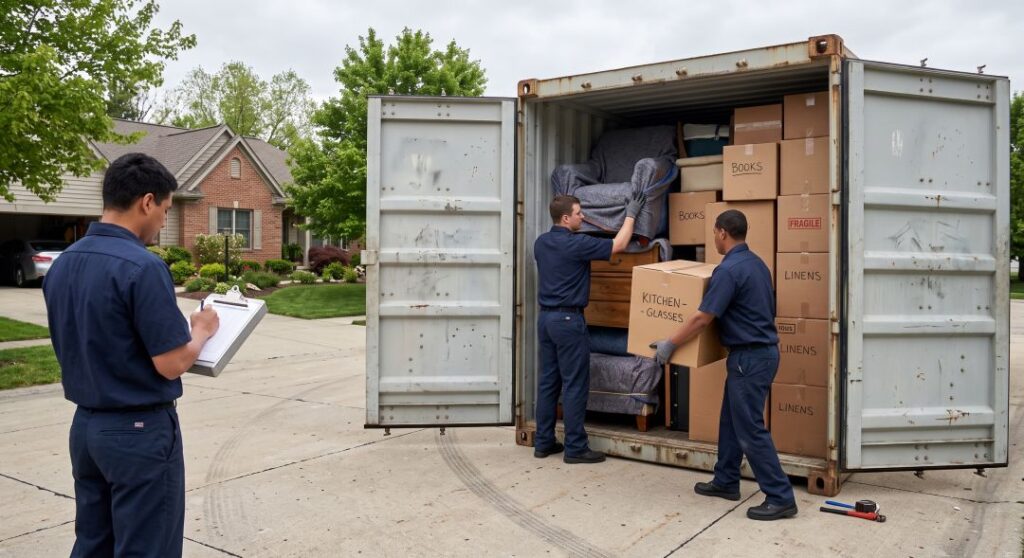
Ocean freight for household goods is priced on shipment volume, measured in cubic feet. Weight matters for air freight and for a handful of edge cases like a container full of books hitting payload limits, but for a normal move, volume is the meter.
This has a practical consequence people miss: a bulky, cheap sectional sofa costs more to ship than a heavy, compact safe. Ocean freight does not care what your things are worth. It cares how much space they take.
| Container | Load capacity |
|---|---|
| 20-foot dry container | 1,172 cubic feet |
| 40-foot general purpose | 2,390 cubic feet |
| 40-foot high cube | 2,694 cubic feet |
A 20 ft container comfortably handles most two and three bedroom homes. A 40-foot container handles four to five bedrooms. If you land awkwardly between the two, that gap is worth real money, and a good survey will tell you whether shedding 150 cubic feet drops you a tier. Sunset’s shipping container sizes guide has the full dimensions if you want to measure against your own floor plan.
Shared container versus full container
| Shared container (LCL) | Full container (FCL) | |
|---|---|---|
| What it is | Your goods share a container with other shipments | You get the whole container |
| Best for | Studios, one bedrooms, partial moves under about 500 cubic feet | Two bedrooms and up, or anything with fragile bulk |
| You pay for | Only the space you use | The container, full or not |
| Transit time | Longer, waits for consolidation and deconsolidation | Faster and more predictable |
| Handling | More touches, so slightly higher damage risk | Sealed at your home, opened at destination |
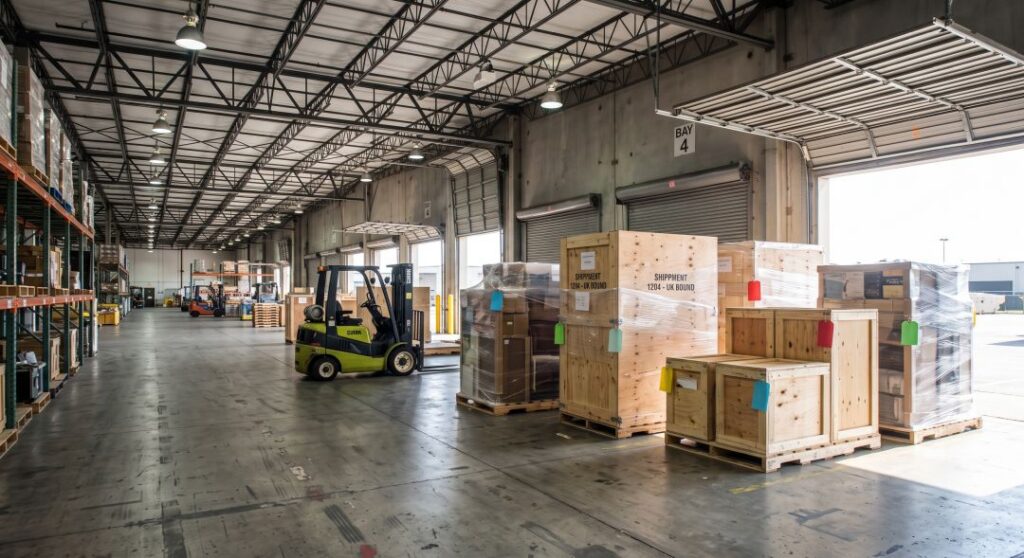
The crossover point sits somewhere around 500 to 600 cubic feet on most routes. Below it, Less-than-Container Load (LCL) usually wins. Above it, Full Container Load (FCL) often costs about the same and arrives sooner with fewer people touching your things.
One honest caveat about LCL: the price is attractive and the schedule is not. Your container waits until it fills. On thin routes that can mean weeks of sitting in a warehouse before anything sails.
Door-to-door, port-to-port, and door-to-port

These three terms explain most of the price gaps between quotes that look otherwise identical.
| Service level | What is included | What you handle |
|---|---|---|
| Door-to-door | Packing, inland transportation, ocean leg, customs clearance, delivery to residence | Signing paperwork |
| Door-to-port | Everything through arrival at the destination port | Destination clearance, port fees, final transport |
| Port-to-port | The sailing between origin port and destination port only | Both ends entirely |
A port-to-port quote will always look cheaper. It is not cheaper. It just moves the destination charges off the page. Before you compare two numbers, confirm they cover the same span, and if you are considering partial service or freight-only options, get the excluded costs in writing.
Port access matters here too. If your street cannot take a 40-foot trailer, you are paying for a shuttle, and that charge exists whether or not anyone mentioned it during the sales call.
Ocean freight versus air freight
| Ocean freight | Air freight | |
|---|---|---|
| Priced on | Volume (cubic feet) | Weight and volume |
| Transit | 4 to 10 weeks door-to-door | 1 to 3 weeks |
| Cost | Baseline | Roughly 4 to 6 times the per-pound cost of sea freight |
| Best for | Furniture and full households | Essentials, documents, high-value small items |
Most people should not choose one. The smart pattern is to send the household by sea freight and air-ship one small consignment of things you cannot live without for two months. Sunset covers the fast lane on its international moving by air page.
What actually moves the number
Destination and shipping route
Route economics are lopsided and they do not track distance. Europe and Canada are dense, competitive lanes with frequent sailings, so per-cubic-foot rates are low. New Zealand, parts of Africa, and inland South America have thinner service and steeper destination handling surcharges. If Europe is your destination, Sunset’s guide to moving from the US to Europe covers the visa and cost-of-living side of the same decision.
Australia and New Zealand add strict biosecurity inspection, which is a real line item, not a formality. Japan and South Korea have excellent port infrastructure but tight residential access that often forces a small-truck shuttle. The Middle East varies enormously by country. Mexico and Canada are frequently cheaper by road than by sea, and an honest mover will tell you so.
Seasonality
Summer is peak. June through August is when families with school-age kids move, and worldwide demand tightens capacity and pushes prices up. If your moving dates are flexible, shifting to spring or early fall is the single easiest way to cut a few hundred dollars off a quote without cutting service.
Access at both ends
Fifth-floor walk-up in Lisbon. Cobblestone street needing a permit. A gated community that will not admit a container truck. These get priced in, and if nobody surveyed them properly, they get billed later.
The Jones Act quirk nobody mentions
If you are moving to Hawaii, Alaska, Puerto Rico, or Guam, you are not moving internationally, but you are absolutely paying ocean freight, and you are paying it under different rules.
The Jones Act requires cargo moving between US ports to travel on American-built, American-crewed vessels. That shrinks the carrier pool and raises rates. The Federal Reserve Bank of New York found in 2012 that shipping a twenty-foot container of household and commercial goods from the East Coast to Puerto Rico cost roughly $3,063, while the same container to Santo Domingo ran about $1,504 and Kingston about $1,687.
That gap has narrowed since, but the structure has not. If someone quotes a Puerto Rico move at international-lane pricing, ask which vessel it is sailing on.
The container rate in the news is not your rate
Here is the piece that trips up almost everyone who does their own research.
You will find headlines quoting container spot rates. Drewry’s World Container Index rose 4% to $4,526 per 40ft container on August 20, 2026, driven by higher rates on the Transpacific trade route. Reasonable person reads that and thinks: great, a 40-foot container costs about $4,500, so why is my moving quote $11,000?
Because those indices measure commercial import lanes, mostly Asia outbound, on a port-to-port basis. They exclude insurance, customs duties, port fees, terminal handling, inland transportation, and documentation. Your household goods move is US outbound on a different lane, bought through a moving company’s contracted space, and it includes crews, materials, brokerage, and delivery to residence.
The index is a useful barometer for market direction. It is not a price list. Watching it can tell you whether the market is tightening, and right now it is: carriers are raising emergency fuel surcharges by roughly $90 per forty-foot container in mid-September, and the Panama Canal Authority has cut daily transits and lowered maximum draft in anticipation of drought conditions. That kind of pressure filters into household goods rates a month or two later.
If you want the current reading, the Drewry World Container Index updates weekly.
Moving insurance and valuation coverage
These are two different things and the difference is expensive.
Valuation coverage is carrier liability. The basic tier is released value, and it caps liability at 60 cents per pound per article. A 50-pound television worth $2,000 gets you $30. That is not insurance. It is a legal liability limit.
Moving insurance is a separate policy covering replacement value. Expect it to cost roughly 1% to 4% of your declared value depending on coverage type, deductible, and destination. A $50,000 shipment typically runs $500 to $2,000 in premium.
Two rules that actually matter. Insure at replacement cost in the destination country, not what the item would fetch at an American garage sale. And know that most policies exclude items packed by the owner, which is one of the quieter arguments for professional packing on a long ocean transit. Sunset’s moving insurance page lays out the coverage tiers.
How to compare international moving quotes without getting burned
Three or four quotes, and read them like a contract, because that is what they are.
Verify the license first
Any company handling ocean freight for you should hold a Federal Maritime Commission license. You can check any mover against the FMC’s public list of licensed and bonded ocean transportation intermediaries. Licensed US-based NVOCCs post a $75,000 bond, which is your recourse if things go wrong. The FMC licensing page explains the categories.Insist on a survey
Phone estimates on volume are guesses. Professional movers who want your business will do a video or in-home survey and produce a cubic-foot number someone will stand behind.Ask what kind of estimate it is
Non-binding estimates move. Not-to-exceed estimates cap your exposure. Flat-rate quotes are cleanest. These are not the same product and the difference shows up on delivery day.Get destination charges itemized in writing
In the destination currency, with the exchange rate assumption stated. This is the line item that turns a good quote into a bad invoice.Read the exclusions
This is where the money hides. Sunset’s guide on moving contract clauses to know walks through the five clauses that actually protect you.
A word on the moving cost calculator tools you will find everywhere. An international moving cost calculator is fine for a rough order of magnitude. It cannot see your staircase, your street, or your destination agent’s fee schedule. Use it to set expectations, then get a real survey.
The market has plenty of capable international moving companies. Van line networks like Allied Van Lines, United Van Lines, Mayflower Transit, and North American operate through agent systems and handle high volume. SIRVA runs large corporate relocation programs. International Van Lines and Armstrong work through licensed agent networks. U-Haul serves the self-pack end. The practical difference is whether overseas shipping is the entire business or one department inside a domestic operation, because that determines who picks up the phone when your container is sitting at a foreign port.
Things to consider before you book
The freight bill is not the move. An overseas move carries a whole second budget outside the container, so plan for the rest of it.
- Visa and immigration expenses. Application fees, legal help, document translation, and apostilles. Start months ahead. Some approvals take longer than the sailing.
- Passports. Check expiration dates now. Many countries require six months of validity beyond arrival.
- Customs paperwork. Inventory lists, valued inventories, proof of residency. Errors here cause port storage charges, which accrue daily.
- Travel costs. Flights, temporary accommodation, and the gap weeks between your departure and your delivery.
- Vehicle shipping. Car shipping abroad runs on separate paperwork and separate import fees. Whether it makes sense depends entirely on the destination. Sunset’s overseas vehicle shipping page covers containerized and roll-on options.
- Pet shipping. Health certificates, vaccinations, and country-specific timelines that can run months. Start at the USDA APHIS pet travel page.
- Storage. If your housing abroad is not ready, you need somewhere for your household goods to sit.
- What not to ship. American sectionals do not fit European stairwells. King beds do not fit most European bedrooms. Voltage differs. Every cubic foot you do not ship is money back, and the honest answer is that a lot of what people ship should have been sold.
Frequently asked questions
- How much does international moving cost by ocean freight?
- Most ocean freight moves from the United States cost between $1,500 and $18,500 door-to-door. A studio in a shared container starts near $1,500, a three bedroom typically runs $5,000 to $12,000, and a four or five bedroom household in a 40-foot container reaches $8,000 to $18,500. Volume and destination drive the number more than anything else.
- How is ocean freight priced, by weight or by volume?
- By volume. Ocean freight for household goods is calculated on shipment size in cubic feet. Weight only becomes the constraint on unusually dense loads that hit container payload limits. Air freight, by contrast, is priced on both weight and volume.
- Will I pay customs duties on my household goods?
- Usually not, if the goods are used personal effects and you meet the destination country’s residency requirements. Rules vary by country and the paperwork is strict. New items, alcohol, and vehicles are commonly excluded from duty-free treatment and attract import fees.
- When is the cheapest time to move overseas by sea?
- Spring and early fall. Summer is peak season worldwide, so June through August brings higher rates and tighter capacity. Shifting your moving dates outside that window is the simplest lever most people have.
Why people choose Sunset International Shipping
Sunset International Shipping is a Santa Barbara based international moving company licensed by the Federal Maritime Commission under FMC #023860N, moving households to Europe, Australia, New Zealand, Canada, Mexico, Japan, South Korea, the United Kingdom, and destinations across Asia, Africa, South America, and the Middle East. What clients point to most often:
- Transparent, flat-rate pricing with no hidden fees or surprises for international moves.
- Comprehensive international moving services including air and sea freight, packing, storage, vehicle shipping, and custom crating.
- Personalized service with a dedicated consultant as a single point of contact throughout the move.
- Robust global network of 150+ agents ensuring safe and professional handling worldwide.
- 30 days of free secure, climate-controlled storage to ease the moving process.
International relocation rewards the people who plan early. If you want a real number instead of a range, the starting point is a survey. Request a free moving estimate or call 805-209-1426, and you will get an itemized quote built on your actual inventory and route rather than a national average.